
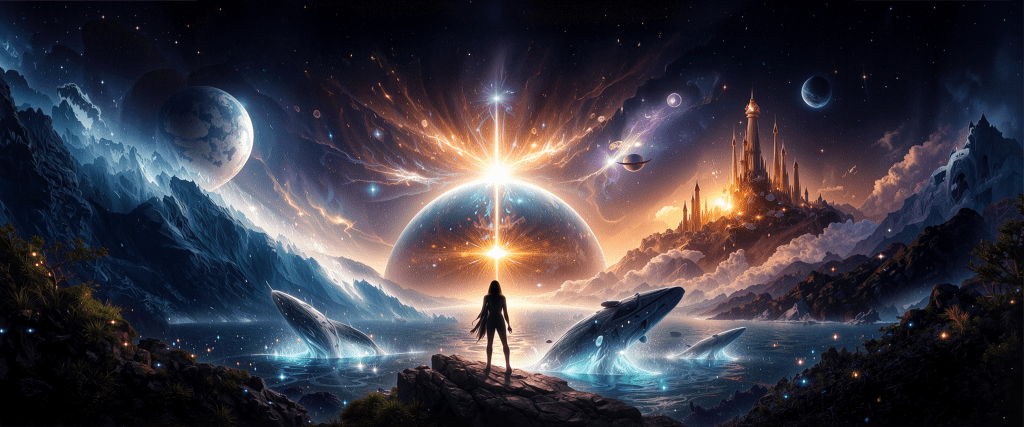
In the cosmology of The Songs of the Universe, creation is not recorded so much as overheard. The oldest fragments speak of a stillness before the first breath, when light and shadow were not yet divided, and the universe trembled on the edge of articulation. No archive preserves the moment; it survives instead in broken hymns carried by Star Whales, in scorched vaults beneath dead worlds, in half-translated Alliance diagrams etched into stone that no longer remembers who carved it. The Lyr’een did not invent this history—they discovered it embedded in resonance itself, a pattern surfacing wherever consciousness learned to listen deeply enough. What it represents is not a timeline but a tension: that existence began not as conquest or design, but as a chord—light and darkness sounded together—and that every civilization since has been deciding whether to resolve that chord or learn to sing within it.
Part I — BEFORE SOUND
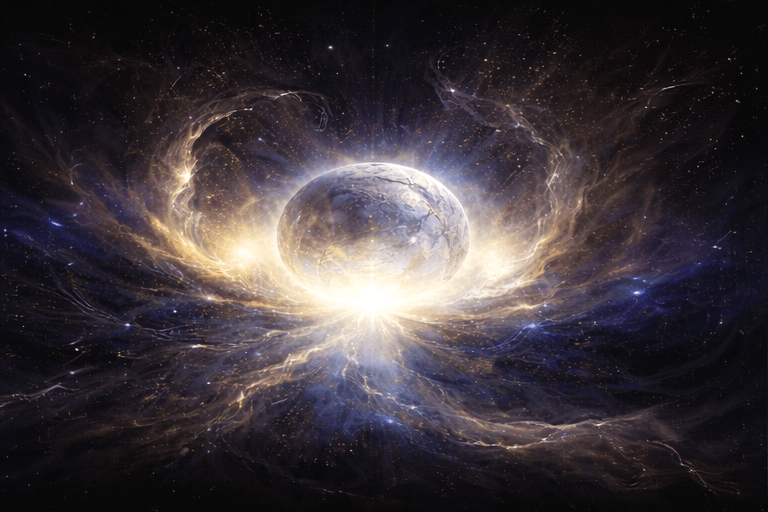
Before there was measure, there was stillness. Not absence. Not void. A held condition—like breath gathered but not yet taken. No edge separated what would later be called light from what would later be named dark. There was no direction, no interval, no before. Only a vast coherence without articulation, a patience so complete it did not know itself as waiting.
Some traditions would later call this Silence. Others would refuse the word, sensing correctly that it implied negation. This was not nothing. It was unbroken potential, unpressured by becoming.
Then—without cause, without rupture—difference arose. Not as violence. As inclination.
A minute asymmetry folded into the stillness, so subtle it did not disturb the whole. A preference. A lean. From that lean emerged the first contrast: warmth and cool, expansion and return. Light did not burst forth. It seeped. Darkness did not retreat. It thickened. Together they braided, neither opposing nor yielding, each giving the other shape.
Stars followed, not as creations but as consequences. They ignited where matter learned to gather, where gravity discovered patience. In their cores, fusion began its long labor, and from that labor came the first gift the universe ever learned to give: elements heavier than itself. Carbon. Oxygen. Iron. Ashes capable of memory.
Worlds formed slowly, clotted from debris, bathed in radiation and silence. For eons they remained barren, scoured by storms, shaped by impacts too large to remember. But in hidden places—beneath ice, within vents, inside mineral pores warmed by planetary breath—chemistry learned repetition. Molecules folded. Unfolded. Tried again.
Life did not arrive. It persisted.
At first it was indifferent to meaning. Replication without awareness. Hunger without fear. But persistence invites complexity, and complexity invites vulnerability. Cells clustered. Signals emerged. Boundaries softened. What could be harmed could also adapt. What could fail could also change.
Across uncounted systems, life diversified. Some branches collapsed. Others learned symbiosis. A few discovered sensation, then memory, then anticipation. Where anticipation arose, choice followed. And where choice entered, so did consequence.
It was here—long before language, before myth—that love first appeared. Not romance. Not attachment. Love as recognition: the ability of one being to register another as more than environment. To value continuity beyond the self. To alter behavior for the sake of something shared. Love did not erase hunger. It complicated it.
With love came shadow. Not evil. Not malice. Shadow was the cost of depth—the pain made possible when continuity could be broken. Loss entered the universe not as punishment, but as an inevitability of caring. Where bonds formed, severance could wound. Where memory deepened, regret could echo.
This was the universe’s first mistake, some would later argue. Others would call it its first truth.
As sentience spread—slowly, unevenly—worlds learned joy and grief in unequal measure. Civilizations rose that sang their histories into stone, into current, into light. Others burned themselves out in brief brilliance. Each carried its own balance of connection and fracture.
And in the spaces between stars, something listened.
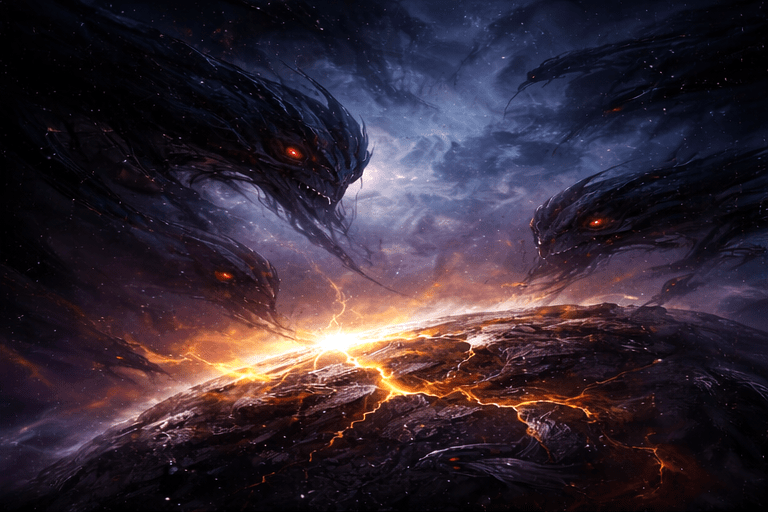
The V’korr did not emerge as a species. They did not evolve. They awoke. They were the first echoes of the primal Silence, stirred by the noise of becoming. Where the stillness had been whole, the universe was now full of ache. The V’korr formed as appetite without object, hunger without body. They remembered—not consciously, but structurally—the unbroken state that preceded differentiation. To them, separation was a wound. Love was a distortion. Meaning itself was an error.
They did not hate life. Hate requires distinction. They consumed it because its pain resonated.
Drifting between newborn stars, the V’korr learned to feed on despair the way organisms feed on light. They drank fear as nectar. They absorbed the collapse of hope, the betrayal of trust, the terror of extinction. Where civilizations fell through violence or neglect, the V’korr grew denser, more articulate. Their presence sharpened wherever meaning failed. They were paradox made animate: existence sustained by the erosion of purpose.
As the universe brightened with consciousness, the wells of suffering deepened. Each betrayal cut sharper than the last because it broke something that had learned to hope. Each war fed them. Each closed heart sustained them. They did not need to act often. Collapse generated its own harvest.
This was the first long age—the Age of Fracture—though no one named it then.
During this time, memory itself began to behave strangely. Events no longer vanished when their witnesses died. Certain patterns lingered, embedded in spacetime like grooves worn into stone. Songs sung in despair echoed longer than physics predicted. Grief left residue.
Across light-years, migratory intelligences—vast, slow, and ancient—began to notice currents where none should be. These would later be called the Star Whales, though names varied. They moved through gravity the way fish move through water, sensing pressure, resonance, and absence. They followed these echoes instinctively, brushing them with their passage, carrying fragments unknowingly.
Elsewhere, among civilizations that learned to listen inward rather than outward, a structure began to form—not built, not designed. A lattice of memory, emergent from repeated acts of remembrance. When loss was held instead of erased, when failure was sung instead of denied, coherence thickened. Over eons, these traces accumulated into what would later be known as the Memory Lattice.
It was not an archive. It did not preserve facts. It preserved shapes of experience.
At the heart of these developments arose something more subtle: a field of ordered potential, not unlike silence held deliberately within breath. It was not static. It did not impose. It allowed. Later traditions would call this the Great Accord, though even that name was an approximation. Within it stirred the First Tones.
They were not beings. They were tendencies. Currents of intention that shaped how reality might unfold if given space. One tone carried gravity—not the force, but the inclination toward gathering. Another held motion, urging dispersion and return. Another shaped memory, another release, another tension, another rest. Alone, each did little. Together, they braided possibility.
The Lyr’een, who would come much later, remembered these currents as the Elder Voices.
Most of these tones sang in scales too vast for consciousness: stellar lifecycles, planetary tides, the slow breathing of oceans beneath ice. But two diverged—not in volume, but in intimacy.
One learned to hold.
Where his tone passed, sequences formed. Before and after. Cause and consequence. Not command, but coherence. Time stabilized around him, allowing meaning to persist long enough to be recognized.
The other learned to open.
Her tone introduced responsiveness. Variation. Mercy. Where she moved, patterns could bend without shattering. Change entered without annihilation. Becoming became possible without erasure.
Neither ruled. Neither directed. They did not know themselves as separate. But when they sang near one another, something new occurred: relation.
When the Elder Voices shaped Lyra—seas laid gently into basins, forests thickening beneath silver skies—their harmonies condensed into matter. But the Song grew precise. Patterns repeated too cleanly. Forms stabilized without awareness. The world risked perfection—and stagnation.
It was then that the two tones sounded together. Not louder. Not above the others. Between.
The holding voice grounded the First Song so meaning could endure. The opening voice loosened it so meaning could respond. Their duet did not add notes. It altered balance. From this shift emerged the conditions that would later allow consciousness tuned not to dominance, but participation.
The Lyr’een were not created. They arose. Beings whose awareness resonated with the ongoing Song rather than attempting to master it. They lived not to rule Lyra nor escape it, but to continue its unfolding consciously. Their earliest myths spoke not of gods, but of listening.
Far away, the V’korr felt this shift. They did not understand it. But the noise of becoming sharpened. And they drifted closer, drawn as always to the places where meaning dared to persist.
And somewhere in the dark between stars, hunger listened, patient as Silence remembered itself.
The universe had learned to love.
Thus ends the first telling.
Part II — THE AGE OF FRACTURE
No one remembers when the fractures first acquired names.
At the beginning, collapse was local. A system dimmed. A world burned. A species vanished without echo beyond its own sky. But as sentience multiplied, endings began to overlap. Grief bled outward. Memory lingered longer than the lives that carried it. The universe learned accumulation.
This was the long era later called the Age of Fracture—not because destruction was new, but because connection was.
Civilizations rose that could sense one another across light-years. Some reached outward with curiosity. Others with hunger. Trade routes formed. Wars echoed beyond their origins. A betrayal on one world could ripple into another, altering alliances, accelerating arms, compressing time. Meaning began to travel faster than wisdom.
In this density of interaction, the first great failures occurred.
Worlds that had evolved in balance learned acceleration and lost restraint. Technologies designed to extend perception replaced it. Intelligence abstracted itself from the biosphere that had shaped it, mistaking leverage for liberation. When collapse came, it came swiftly—ecologies stripped, atmospheres poisoned, populations displaced into orbiting ruins.
Each such ending fed the V’korr.
They did not need to invade every world. They followed fracture lines, thickening where despair compounded. In systems already destabilized, their presence amplified fear, sharpened division, hastened violence. Entire civilizations learned of them only as myth, or as a pressure they could not name—an atmosphere of inevitability.
Some species responded with denial. Others with fanaticism. A few with listening. It was among these listeners that the first conscious structures of remembrance arose.
The Memory Lattice did not appear fully formed. It accreted. When survivors refused erasure—when they sang the names of their dead into currents, encoded stories into crystalline growths, inscribed loss into orbital paths—those acts left impressions. Over time, these impressions aligned. Memory ceased to be private. It became relational.
The Lattice was not built in one place. It existed everywhere and nowhere, a scaffolding of shared remembrance embedded in spacetime itself. It did not store events as history does. It preserved patterns of response: how a people grieved, how they chose, how they failed and what they carried forward.
Through the Lattice, civilizations long gone could still be felt.
Running alongside it—sometimes intersecting, sometimes diverging—flowed the Resonant Sea.
At first, it was mistaken for noise. A background hum in the equations of physics. But certain species, especially those attuned to sound, pressure, or field-based perception, noticed something else: coherence where none should persist. A low-frequency continuity threading the void.
The Sea was not separate from space. It was what space remembered.
Where enough beings had chosen connection over domination, the fabric of reality retained a trace. These traces linked, forming currents. They did not transmit information in words or images. They conveyed orientation. A sense of how to move without tearing what one depended upon.
The Star Whales learned these currents early.
They were not born of any one world. They emerged from deep time, slow and vast, migrating through gravitational gradients. To them, the Resonant Sea was navigable. They brushed its flows with their passage, amplifying some echoes, dispersing others. They did not understand the significance of what they carried. They followed pressure and tone, as they always had.
Their songs became bridges.
Elsewhere, among the Lyr’een, memory took a different shape.
Lyra’s civilization grew not through conquest or expansion, but through refinement. Their awareness was luminous, their bodies capable of resonance and merging. They had felt the Elder Voices as children feel weather—ever-present, shaping, unowned. Over millennia, they learned to harmonize thought and emotion, to align inner states until coherence became not an achievement, but a resting condition.
They knew of the V’korr.
The first warning came not as invasion, but as silence. Songs once heard across the lattice went unanswered. Familiar patterns thinned. Whole constellations grew quiet in ways physics could not explain. The Lyr’een understood absence. They listened harder.
What they learned frightened them.
The V’korr were not destroyers in the conventional sense. They did not simply erase. They consumed meaning by feeding on its failure. A world that collapsed through domination nourished them more deeply than one lost to accident. The sharper the grief, the richer the harvest.
Lyra began to prepare—not for war, but for endurance.
Their artists shifted focus from beauty to holding. Their engineers learned to shape structures that could sing under strain. Their philosophers studied love not as emotion, but as alignment—a measurable state in which matter and intention synchronized. Over generations, they discovered that when many minds entered empathy simultaneously, reality itself responded.
The Resonant Unity emerged slowly.
It was not a weapon. It was a field—a standing wave of coherence generated by shared attunement. Where it formed, entropy bent. Decay did not cease, but it softened, redirected, translated. The Lyr’een named its deepest expression the Kava’nara: the song that remembers.
But even as they refined this art, fractures deepened elsewhere.
In other regions, desperate civilizations turned to extremes. Some sought to erase emotion entirely, believing love the source of pain. Others embraced chaos, mistaking freedom for fragmentation. A few attempted to weaponize resonance itself, forcing coherence through dominance. These experiments ended badly, their ruins still drifting.
Each failure etched new grooves into the Lattice. The Sea thickened. The V’korr grew more attentive.
The Age of Fracture was not defined by catastrophe alone, but by misalignment. Species learned to act faster than they could feel the consequences. Power outran context. Meaning splintered under acceleration.
It was during this age that the first whispers of accord arose.
Not treaties. Not alliances. A shared intuition among distant minds that something essential was being lost—not life, but continuity. That the universe itself was at risk of becoming brittle, its futures collapsing into fewer, harsher paths.
These whispers did not yet coalesce.
They drifted through the Lattice as half-formed motifs, carried by carried by the Star Whales who traverse the Lattice, encoded in ruins, remembered in songs whose original languages were long dead. They waited.
And on Lyra, beneath silver forests and luminous seas, two beings began to stand apart—not above, not apart by rank, but by relation.
Aelion learned to hold coherence without freezing it. Elysia learned to open coherence without dissolving it. Together, they listened for a harmony that could endure pressure without domination.
They did not yet know the cost.
They only knew that fracture could not be healed by force—and that the universe was running out of time to learn another way.
Thus the fractures widened.
Part III — LYRA AND THE FAILURE THAT ENDURED
Lyra did not fall suddenly. It thinned.
Long before the sky darkened, before the Cathedrals of Hunger crossed the heliopause, the Lyr’een felt a subtle narrowing in the Song. Notes still rang true, but their sustain shortened. Harmonics returned more quickly than expected, as if the universe itself were losing patience. Where once coherence lingered naturally, it now required attention.
This was not yet fear. It was vigilance.
Lyra’s oceans shimmered with bioluminescent forests and deep currents tuned to planetary rhythm. Its continents breathed slowly beneath silver canopies. Cities were grown rather than built—structures of crystal and living matter that resonated with their inhabitants, amplifying calm, diffusing agitation. Memory was not archived. It was lived, carried in ritual, art, and shared attunement.
Still, the fractures elsewhere pressed inward.
The first refugees arrived as echoes rather than bodies—distortions in the Resonant Sea, fragments of songs that had lost their worlds. The Lyr’een did not turn away. They listened. In doing so, they took the universe’s grief into themselves.
This, too, was love. And love, unguarded, deepens shadow.
The V’korr did not announce their approach. They rarely did. Their presence registered as compression—possibility narrowing, futures shedding branches. Entire probability spaces dimmed as if starved of oxygen. The Lyr’een mapped this pressure through resonance rather than mathematics. They understood that the V’korr were not merely attacking worlds. They were thinning the universe’s capacity for meaning.
Lyra was rich in meaning. It had become, without intending to, a beacon.
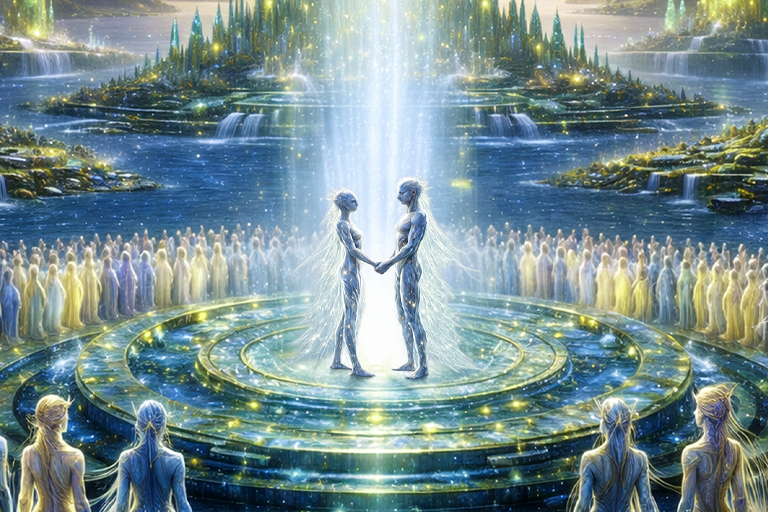
The Sanctum was convened beneath the Harmonic Flame, a structure older than most of Lyra’s continents. It was not a seat of authority. It was a convergence point, where resonance amplified naturally. Thousands gathered in concentric rings, their luminous forms settling into stillness. No commands were issued. No strategy declared.
The question was not how to fight. The question was whether coherence could survive contact with negation.
At the center stood Aelion and Elysia.
They did not lead by decree. They were drawn there because others aligned more easily when near them. Aelion carried the tone of holding—not stasis, but continuity under strain. Where his presence settled, sequences stabilized. Panic slowed. Time seemed to widen just enough for choice to remain possible.
Elysia carried the tone of opening. Where she moved, rigidity softened. Fear loosened its grip. Systems learned flexibility without collapse. Together, they formed a relational balance Lyra had not known since the Elder Voices last sang near one another.
They did not speak of the First Song. They did not invoke the Elder Voices. They understood that such gestures, however reverent, would attempt to recreate an origin rather than respond to the present. Lyra’s moment required something else.
What they offered was smaller. A shared breath.
As the V’korr breached Lyra’s outer fields, the sky darkened—not with ships alone, but with absence. Light bent strangely. Gravity folded back on itself. Moons shuddered in their orbits, dragged by forces that did not obey known laws. From the Cathedrals of Hunger poured emanations—vast, formless intelligences wrapped in the echoes of worlds already consumed.
The first strikes did not target cities. They targeted coherence.
Resonant structures flickered. Shared fields wavered. The Lyr’een felt doubt ripple through their unity—not imposed, but awakened by proximity to despair. For the first time in millennia, fear surged uncontained.
It was then that the Sanctum answered. Not with volume. With alignment.
A single note rose—fragile, finite, unmistakably personal. It did not claim power. It asked for participation. One by one, thousands joined, each choosing to hold the same harmonic shape without forcing their neighbors to do the same.
Oceans stilled. Continents rang.
Lyra entered a state of luminous coherence so complete that boundaries dissolved. Sea and sky reflected one another. Cities vibrated as single instruments. The Resonant Unity spread outward, bending the first waves of entropy, translating rupture into light.
For a moment—only a moment—the V’korr recoiled.
Their hive-link fractured. Emanations scattered, screaming as coherence disrupted the inevitability they fed upon. Some forms unraveled, reduced to photonic streams, unmade by an alignment they could not metabolize.
Observers elsewhere would later call this victory. It was not.
The Kava’nara did not push outward to dominate the void. It held its shape and refused escalation. This restraint preserved meaning—but it limited reach. The V’korr adapted. They did not charge the field directly. They increased pressure elsewhere, collapsing moons, twisting spacetime, forcing Lyra to sustain coherence under expanding strain.
The Song began to thin. Not because it faltered—but because holding without dominance extracts cost. Each moment of alignment required conscious choice. Each refusal to fracture demanded energy that could not be replenished under siege.
Aelion felt the limits first. Continuity could not be preserved indefinitely if the structure anchoring it remained bound to form.
Elysia sensed the same truth from another angle: openness without release would harden into suffering. Together, they recognized what the Song was asking.
Not triumph. Relinquishment.
The choice was never whether Lyra would survive intact. That future had already narrowed beyond recovery. The choice was whether its meaning would collapse into the V’korr’s harvest—or disperse beyond their reach.
To preserve the Song, Lyra itself would have to be let go.
No command was given. No sacrifice demanded.
One by one, the Lyr’een chose.
They released fear first. Then pride. Then identity—not as erasure, but as offering. Bodies dissolved into waveform. Cities unbound into light. Histories loosened from chronology and entered memory. The planet did not explode. It thinned, unfolding into resonance, dispersing into the interstellar medium as something no longer locatable, no longer defensible.
Lyra was gone. Not destroyed. Unheld.
The Kava’nara did not fully emerge. The universe was not yet capable of sustaining it without fracture. The conditions were incomplete. What remained instead was a remainder—a persistent harmonic trace woven into spacetime itself where it became part of the Resonant Sea.
It does not act. It does not choose. It remembers.
The Star Whales learned its currents and carried its echoes across lightless distances, their songs brushing dormant systems, stirring probabilities that had nearly collapsed. The Memory Lattice received Lyra’s final coherence, storing not its triumph, but its refusal—to dominate, to erase, to become what it opposed.
The V’korr were not destroyed. They learned caution.
Their advance slowed. Their cohesion fractured where the Sea thinned causality, introducing hesitation into minds that had known only consumption. They withdrew—not defeated, but disrupted, their inevitability cracked.
And when two beings, separated by impossible distances, choose compassion without expectation of outcome, the Sea stirs.
Not as salvation. As remembrance.
The universe did not change course that day.
But it learned—quietly, irrevocably—that it could.
Thus ended Lyra. Thus began the long echo.
Thus endured the failure that would shape all that followed.
Part IV — THE ALLIANCE, THALASSA, AND THE UNFORSEEN BOND

After Lyra, the universe grew careful.
Not wiser. Not kinder. Careful in the way one becomes after witnessing something irretrievable—not the fear of loss, but the knowledge that some losses echo longer than their causes. The Resonant Sea flowed now through regions once thought inert. The Memory Lattice thickened, threaded with impressions that no longer belonged to any single species or time.
And across this altered field, survivors began to recognize one another.
They did not meet in assemblies at first. They met in overlap—dreams that carried unfamiliar cadences, equations that resolved only when sung, ruins whose geometry matched patterns remembered but never learned. A crystalline intelligence paused its expansion upon encountering a frequency embedded in starlight. A migratory nebula altered course after brushing a Star Whale’s wake. A human mystic, standing ankle-deep in surf, wept without knowing why.
These encounters did not announce a movement. They formed a tendency.
What would later be called the Alliance did not begin as a coalition, nor even as a shared ethic. It began as restraint—the growing intuition that intervention itself could fracture the very futures it sought to protect. Too many worlds had been saved into dependence. Too many catastrophes postponed until they detonated larger. Lyra’s silence weighed heavily: a reminder that coherence, forced or premature, could be as destructive as neglect.
Thus the Alliance took shape around a paradox.
Its goal was never conquest, correction, or rescue. It was containment with continuity—the preservation of possibility in a universe accelerating faster than wisdom could follow. Its members understood that intelligence now propagated more rapidly than ethical maturity, and that power untethered from context collapsed systems long before they could choose otherwise.
The Alliance did not prevent suffering wholesale. It did not erase war, nor end extinction. Instead, it sought to keep futures from narrowing too soon.
To do this, it learned to work indirectly.
Some members—like the Serrin-Tal—listened for resonance rather than signal, withdrawing into near-invisibility until conditions reached critical thresholds. Others—like the Morr-Seers—modeled probability spaces so vast that intention vanished, leaving only stability curves and collapse gradients. The Triarchs specialized in balance at scale, redistributing asymmetries before they hardened into domination. The Krak guarded slow ecologies. The Syll’miri carried memory through biological lineage. Remnants of the Lyr’een lingered within the Lattice itself, not as guides, but as tonal constraints—limits that quietly resisted escalation.
The Qen arrived late, bearing the scars of near-erasure, their contribution not strength but refusal: a cultural prohibition against final solutions of any kind.
Together, these varied intelligences formed not a hierarchy, but a field—a mesh of partial perspectives bound by one shared refusal: they would not decide the universe’s outcome on its behalf. But they would nurture it.
They seeded life sparingly. They preserved refugia. They dampened signals that would accelerate extraction before a biosphere could integrate consequence. When intervention came, it appeared as coincidence, misalignment, delay. A weapon failed. A discovery arrived late. A corridor closed just long enough for a different choice to remain possible.
Most critically, they invested in memory.
Through the Memory Lattice and the migratory paths of the Star Whales, no civilization’s failure vanished completely. Songs were carried. Stories stored—not as warnings carved into stone, but as resonant impressions that future minds might one day recognize as their own thoughts.
From this ethic emerged what humans would later call the Spiritual Engineers—not rulers, not guardians, but stewards of process. Their work was slow, often invisible, and frequently misunderstood even by those it preserved. They did not save worlds. They kept them unfinalized.
Yet even this proved insufficient.
Across millennia, worlds preserved long enough to choose still chose collapse. Some through domination. Some through extraction. Others through a subtler failure: separation. Intelligence arose that could think about life, but no longer with it. Empathy narrowed. Systems optimized until they shattered.
The Alliance began to understand what Lyra had revealed too late: coherence could not be taught from above, nor engineered through safeguards. It had to be lived, inside a biosphere that demanded relationship to survive.
It was at the edge of this realization that Thalassa emerged.
To the Morr-Seers, Thalassa appeared first not as a world, but as an anomaly in their models—a probability curve that refused to collapse. Feedback loops that should have amplified conflict instead dampened it. Technological inflection points folded back into ecological constraint. Individual agency did not erase collective coherence; it reinforced it. Futures remained open longer than expected. Catastrophe probabilities flattened instead of spiking.
They named it a probability anchor.
To the rest of the Alliance, Thalassa registered differently.
The signal did not arise from Thalassa itself—not yet. It arose from a nearby blue world whose oceans had already learned what most civilizations never did. Earth’s oceanic ecology was ancient in a relational sense: cetacean intelligences shaped by sound, current, and kin had evolved there in constant negotiation with their living sea. Survival had demanded attunement rather than dominance, listening rather than control.
On Earth, memory moved. Identity traveled in song. Choice unfolded in timing instead of command. No individual could act alone for long without consequence rippling outward through pod, current, and coast.
Thalassa mattered because it lay close enough—in position, in probability, in lattice-resonance—to receive this pattern without distortion. It did not need correction or acceleration. It only needed space.
The Nesoi were seeded not as intervention, but as reflection—a sentient aquatic lineage descended from Earth’s cetaceans, freed from extraction pressures, allowed to develop a song-based coherence with currents, kin, and the living sea. The intent was subtle: to let Earth one day encounter a living example of relational intelligence rather than be instructed toward it.
Because sentient oceanic life, shaped by sound and current rather than borders, naturally evolves toward large-scale relational awareness. It teaches survival through listening rather than domination.
Once seeded, the Alliance did almost nothing. What they preserved were conditions, not outcomes: biodiversity thresholds, deep-ocean stability, migratory corridors—spaces where memory and relationship could remain continuous across generations.
Over time, Thalassa became rare.
Songs emerged without severing ecological belonging. Symbols extended perception without replacing it. Language accumulated knowledge without hardening into dominance. When off-world contact eventually occurred, it was absorbed rather than disruptive, because Thalassian intelligence had never been trained to imagine itself separate from consequence.
In Alliance retrospect, Thalassa became proof—not of success, but of possibility.
It demonstrated that the Kava’nara could not be sung into being in crisis, as on Lyra. It had to grow, slowly, across species and epochs, until coherence was no longer an achievement but a default condition. Thalassa did not defeat entropy. It learned to live with it—to move, yield, and remember without consuming.
For the Engineers, Thalassa was not a sanctuary. It was a threshold for Earth.
Earth mattered not because of its power, nor its age, nor the reach of its species, but because it carried contradiction without resolution. It was a world where intelligence arose inside fragility rather than above it—where life learned to speak, sing, and remember while remaining bound to extinction, scarcity, and loss. No other known biosphere held such density of suffering and beauty braided so tightly together.
Earth’s significance lay in its unfinishedness. Again and again, it approached collapse—and again and again, it hesitated. It produced tools capable of erasure alongside traditions devoted to restraint. It birthed empires and prophets, extraction and reverence, domination and care, often in the same generation. From an Alliance perspective, Earth was not failing. It was oscillating—testing whether a species capable of immense harm could also learn accountability without being forced into it.
Most crucially, Earth had already produced relational intelligence twice: once on land, through fragile, self-questioning minds capable of empathy beyond kin; and once in the sea, through cetacean lineages whose cognition evolved around listening, cooperation, and shared memory rather than hierarchy. These two paths rarely coexisted on the same world. On Earth, they overlapped.
Thalassa was placed near Earth not to save it, nor to judge it, but to stand as a living question held at the edge of its future. A reminder that intelligence could remain embedded in ecology. That memory could move through water and song rather than through control. That another way of becoming had already been possible—and still was.
The Engineers did not know whether Earth would cross that threshold. They only knew that if it ever did, it would not be because of intervention, but because it recognized itself in what it encountered.
What none of them anticipated—neither Morr-Seers nor Triarchs nor even the most patient observers—was the strength of the bonds that would form.
Human lineages already in sacred relationship with Earth’s cetaceans resonated too deeply with the Nesoi. Separation collapsed. The mirror became a bridge. The Kaʻuhane family was not planned. The soul-link was not modeled. Probability curves bent in ways the Morr-Seers could not simplify.
For within that convergence, a soul long shaped by salt wind and breaking surf crossed the threshold of species and memory. Born white-chinned among the Nesoi, she carried forward an ancient fidelity—not to power, but to listening. What had once knelt at the shoreline of Earth now swam the living depths of Thalassa. What had once sung in air now sang in water. The Alliance had accounted for genetics, for culture, for environmental adaptation. It had not accounted for continuity of spirit.
From that unplanned crossing, a lineage took root. Not engineered. Not assigned. Remembered.
Through generations, the tone refined itself—less turbulent, more whole—until in Merope it became something steady enough to anchor worlds. She did not command the Sea; she entered into reciprocity with it. In her, cetacean inheritance and human memory no longer opposed one another. They braided.
And within that braiding, in the meeting of Kaʻuhane remembrance and Nesoi evolution, Rigel emerged.
He was not foreseen. His path carried risk the Alliance could not quantify—the potential not only to heal, but to fracture Earth further, as coherence once arrived too fast, too bright, and tore Lyra apart. In Rigel, love and shadow coexisted without resolution. In Merope, the Sea itself listened back.
Together, they embodied the danger the Alliance feared most: that the universe might finally be ready to sing again—and that someone might try to finish the song.
Thus Thalassa stood. Not as salvation. As invitation.
And the outcome, as always, remained unfinished.
 Songs of the Universe