
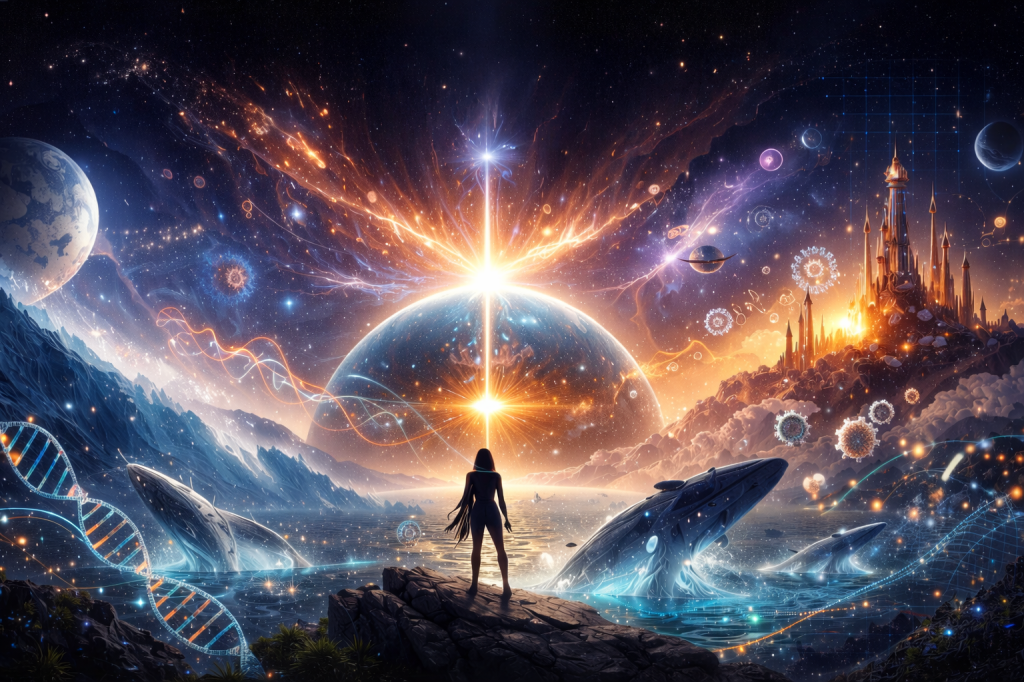
What makes the Songs of the Universe trilogy distinctive is not that it borrows the language of science, but that it is structurally built upon real scientific disciplines—cosmology, astrobiology, evolutionary biology, marine bioacoustics, climate science, systems theory, and anthropology—and then extended through mythic imagination. The trilogy’s speculative elements are anchored in current peer-reviewed research rather than invented technobabble. Below is a synthesis of the scientific foundations that underlie the narrative arc across all three books.
SCIENTIFIC FOUNDATIONS
Cosmology and Stellar Evolution
At its largest scale, the trilogy rests on modern cosmology and nuclear astrophysics. The idea that consciousness emerges within a universe shaped by thermodynamic gradients echoes foundational work in stellar nucleosynthesis (Burbidge et al., 2011) and contemporary models of heavy-element enrichment in planetary systems. The destruction of worlds by advanced civilizations draws upon real astrophysical mechanisms—gravitational manipulation, asteroid redirection, planetary core destabilization—derived from planetary science literature and impact modeling research (e.g., Asphaug, Shoemaker ).
The Engineers’ cosmic perspective is informed by decadal surveys in astronomy and planetary science, especially research on exoplanets, planetary system formation, and habitable zones. The trilogy’s depiction of Type III–scale civilizations and galactic engineering extrapolates from Kardashev-scale energy frameworks and current debates about astroengineering, megastructures, and entropy management in large-scale systems.
Rigel’s encounters with civilizations that manipulate matter at planetary scale are grounded in real discussions of stellar energy budgets, gravitational vector modeling, and planetary interior physics (as described in modern planetary decadal strategies). Even the concept of entropy minimization versus entropy acceleration reflects legitimate thermodynamic debates about order, complexity, and dissipative structures in cosmological systems.
Quantum Physics and the Architecture of Reality
Quantum physics provides a deeper structural layer beneath the trilogy’s cosmology. Drawing on the work of Feynman, the narrative reflects the understanding that reality at its most fundamental level is probabilistic rather than strictly deterministic. Matter is treated not as isolated objects but as excitations of underlying quantum fields. This field-based ontology informs the trilogy’s recurring metaphor of “song,” representing harmonic oscillations and dynamic interactions rather than mysticism. The V’korr, in particular, embody an advanced mastery of field dynamics, operating at the level of spacetime geometry and energetic coherence rather than conventional matter-based engineering.
The search for unification in modern physics, articulated by theorists such as Kaku, shapes the trilogy’s broader cosmological architecture. The possibility that gravity, electromagnetism, and the nuclear forces emerge from a deeper unified framework supports the depiction of civilizations capable of manipulating gravitational vectors and planetary-scale energy flows. The V’korr’s technological sophistication is grounded in extrapolations from higher-dimensional models and quantum field theory, allowing them to influence curvature, resonance, and energy distribution across vast spatial scales without violating established physical principles.
Importantly, the trilogy avoids conflating quantum mechanics with mysticism. Instead, it aligns with decoherence theory and quantum thermodynamics, recognizing that macroscopic order arises from measurable interactions within complex systems. Probability amplitudes, energy conservation, and information dynamics underpin both the scientific worldbuilding and the moral architecture of the narrative. In this framework, coherence is not supernatural alignment but emergent stability across scales—from quantum fields to planetary systems—and the V’korr represent a civilization that has learned to operate consciously within those constraints.
Astrobiology and the Search for Life
The Spiritual Engineers’ mission—seeding, preserving, and nurturing biospheres—is rooted in contemporary astrobiology. NASA and the National Academies’ strategies for the search for life, planetary protection requirements, and ocean-world exploration provide the scientific backbone for Thalassa, Enceladus-like oceans, and cryogenic biosphere preservation.
Ocean worlds such as Europa and Enceladus inspire the trilogy’s sub-surface civilizations. Real research into hydrothermal vents, chemosynthesis, and microbial survival in extreme conditions informs the plausibility of life thriving beneath ice shells or within methane-rich depths. Discussions of noble gases, planetary differentiation, and atmospheric composition inform the planetary worldbuilding.
The Engineers’ ethical debates about intervention versus observation parallel real planetary protection protocols: preventing forward contamination, avoiding ecological collapse, and balancing scientific curiosity with stewardship.
Evolutionary Biology and Cetacean Origins
The trilogy’s depiction of the Nesoi and cetacean-derived intelligence is grounded in paleontological research on whale evolution, particularly the transition from terrestrial mammals (e.g., Ambulocetus) to fully aquatic forms (Thewissen, 2014). The evolutionary plausibility of aquatic intelligence is explored through comparative neurobiology, encephalization, and marine sensory adaptation.
The notion that intelligence can evolve in oceanic environments without reliance on fire or metallurgy is examined through real biological constraints: tool use limitations underwater, alternative technological pathways, and acoustic-based cognition.
Rigel’s arc intersects with evolutionary anthropology—human development from early hominins through cultural complexity—while Orion’s backstory draws from environmental trauma and adaptive psychology.
Bioacoustics and Whale Song Research
A central scientific inspiration for the trilogy’s cosmology of “song” is empirical whale song research. Studies on humpback whale song structure, cultural transmission, morphological notation, and cross-ocean song migration provide the real-world basis for the Resonant Lattice concept.
Research showing that humpback songs evolve culturally across ocean basins parallels the trilogy’s depiction of interstellar signal harmonics. Whale songs’ structured, hierarchical phrasing informed the narrative idea that the universe contains layered informational harmonics rather than chaotic noise.
The trilogy’s interpretation of resonance as relational alignment—rather than mystical vibration—draws from acoustic physics, signal propagation in fluid mediums, and complex pattern evolution in social mammals.
Climate Science and Earth Systems
The damaged Earth and the fragile ecosystems of Thalassa are grounded in contemporary climate science and Earth systems research. Loop current modeling, tropical cyclone microphysics, ocean heat transport, and carbon sequestration strategies inform both the environmental collapse and the restoration movements described in the narrative.
Research on extreme weather attribution and anthropogenic climate forcing underlies the depiction of cascading ecological breakdown. Ocean-based carbon removal research informs environmental efforts and treaty reforms.
The trilogy treats planetary collapse not as sudden apocalypse but as systems failure across interlinked atmospheric, oceanic, and political networks—a perspective aligned with Earth system science and resilience theory.
Impact Science and Planetary Catastrophe
Descriptions of asteroid redirection, shocked quartz ejecta, and extinction-level events are rooted in impact geology and planetary collision models. The trilogy’s portrayal of civilizations that “edit” planets through gravitational manipulation extrapolates from real studies of orbital dynamics and hit-and-run planetary collisions.
The idea that civilizations can destroy themselves through internal fracture rather than external invasion echoes research into systemic risk and complex adaptive system collapse—bridging astrophysics with sociological entropy.
Genetics, Synthetic Biology, and Alternate Coding
The trilogy’s treatment of biological divergence, alternate genetic coding, and engineered species reflects real synthetic biology discussions about codon reassignment, biocontainment, and genomic recoding. The Engineers’ debates over modifying life versus allowing natural evolution mirror current ethical discussions in gene editing and synthetic ecosystems.
The possibility of alternate genetic codes informs the plausibility of non-terrestrial biochemistry.
Indigenous Knowledge and Ecological Cosmology
While grounded in modern science, the trilogy also draws from Indigenous ecological frameworks. Hawaiian, Lakota, African, and Aboriginal cosmologies—especially concepts of relational land stewardship and non-dual ecological identity—shape the philosophical spine of the books.
Rather than opposing science, these traditions are presented as complementary epistemologies: relational systems thinking embedded in lived ecological practice. This convergence aligns with contemporary scholarship in environmental anthropology and decolonial ecology.
Systems Theory, Integral Theory, and Holarchies
Across all three books, the universe is structured as a holarchy—nested systems within systems. This framework is informed by integral theory (Wilber), spiral dynamics (Graves, Beck and Cowen), and complex systems research. The Engineers’ understanding of planetary development mirrors stage-based models of cultural evolution and collective consciousness expansion.
The Kornak represent a hyper-rational, entropy-accelerating system optimized for efficiency over relationship—an extrapolation of technocratic systems detached from ecological feedback loops.
Psychology and Archetypes
Rigel’s and Orion’s internal journeys are informed by Jungian archetypal psychology and shadow integration theory. The idea that civilizations collapse through unresolved grief mirrors psychological models of trauma replication across generations. The cosmic battle is therefore both astrophysical and intrapsychic.
The Core Scientific Thesis of the Trilogy
The trilogy proposes—within speculative fiction—that:
- The universe trends toward increasing complexity through thermodynamic disequilibrium.
- Life is not accidental but statistically emergent under favorable planetary conditions.
- Intelligence can either accelerate entropy destructively or cultivate relational coherence.
- Cultural transmission (like whale song) is a real evolutionary force.
- Biosphere collapse is an emergent outcome of anthropogenic forcing acting on interconnected atmospheric, oceanic, and ecological processes.
- Consciousness may scale beyond the individual into planetary and interstellar networks.
None of these ideas are mystical inventions; each is extrapolated from peer-reviewed research in astrophysics, evolutionary biology, climatology, anthropology, and systems science.
The trilogy’s mythic language of song, resonance, and spiritual engineering is not a rejection of science—it is an attempt to narrativize it. It asks what it would mean if the data of the universe were also a story.
 Songs of the Universe